Website or online store? Compare build cost, time and obligations (fiscalisation, payments, delivery) and take a quick test to decide what you need.
A website is enough when customers buy after an enquiry or a quote, while an online store pays off when you sell products with a clear price online, without your involvement.
Many businesses start by asking "do we need an online store?", but the more useful question is how your customers buy from you today. If they call first, send an enquiry or walk into your shop, a website that brings in those enquiries is worth more than a cart nobody uses. If customers message you every day asking "how much is it and do you ship?", it's time for an online store. Below are the differences in cost, build time and obligations, a quick test and answers to common questions.
What is a website, and what is an online store?
A website presents you and your services. Its job is to help visitors find you on Google, convince them you're the right choice and get them to contact you: by phone, enquiry or booking. The sale is agreed afterwards, in a conversation or a quote.
An online store sells for you. The customer picks a product, adds it to the cart, pays by card or cash on delivery and receives an invoice. You receive an order to pack and ship. A store has everything a website has (about, contact, blog), plus a catalogue, cart, payments, delivery and invoicing.
When a website is enough
- You sell services. Tradespeople, lawyers, accountants, hairdressers, holiday apartments and agencies sell time and expertise, not a boxed product. Customers need trust and an easy way to contact you.
- The price depends on the enquiry. When you have to calculate the price (measurements, quantity, customisation), a cart with fixed prices doesn't help. A good enquiry form and a fast quote work better.
- You sell to other businesses. B2B customers usually want a quote, a discount and payment by invoice.
- Sales happen in your shop. The website brings people in: opening hours, map, offers and promotions.
For these businesses the best choice is a fast business website with clear services and contact details. See how we approach website development.
When you need an online store
- The product has a clear price that customers see and accept without talking to you.
- Your customers are all over Croatia or the EU, not just in your town.
- You already sell through Instagram or Facebook and answer the same questions about price, size and delivery every day.
- You have stock and can ship parcels, or you deliver digitally (e-book, course, gift voucher).
- You want to sell when you're not working: evenings, weekends and while you're on holiday.
Read what goes into building one on our online store development page.
The middle ground: a catalogue with enquiries
There is a third option many people skip. The website shows your products with photos, descriptions and a price (or "price on request"), but instead of a cart the customer clicks "Send an enquiry". You reply with a quote or pro forma invoice, and the customer pays by bank transfer.
A catalogue with enquiries works well for made-to-order products, wholesale, expensive items customers want to discuss, and businesses still testing whether online sales will work at all. If the website is built well, the catalogue can later be upgraded into a real online store, with no new website and no lost Google rankings.
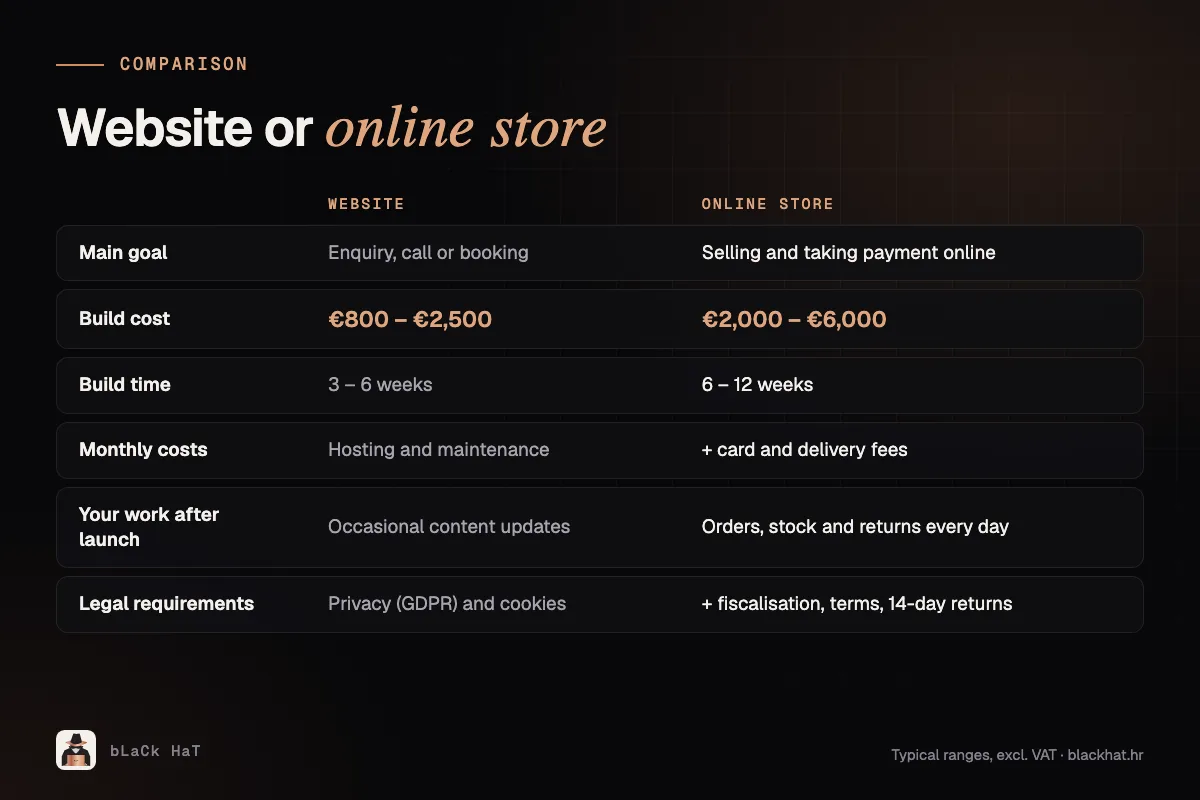
Differences in cost, time and obligations
Build cost
A business website with a CMS typically costs €800 – €2,500, and an online store €2,000 – €6,000 (excluding VAT). A store costs more because, besides the design, it needs a catalogue, cart, payments, delivery, invoicing and testing of every step of the purchase. For a detailed breakdown of prices and what they depend on, read How much does a website cost in 2026?
Monthly costs
Both need a domain, hosting and maintenance. An online store also pays the card processor a fee on every transaction (usually a few percent of the amount), has a contract with a courier or parcel lockers, and often needs bigger hosting because of more traffic and data.
Build time
A website is usually ready in 3 – 6 weeks, an online store in 6 – 12 weeks. Most of that time isn't programming but content: photos and descriptions of every product, prices, variants (sizes, colours) and delivery terms.
Your work after launch
You refresh a website now and then with a new reference or article. An online store is daily work: orders, packing, stock, customer questions, returns and promotions. Before you decide, work out who will do it and how many hours a week it takes.
What an online store needs besides the build
- Fiscalisation and invoices. In Croatia, since 1 January 2026 (Fiscalisation 2.0) every invoice to consumers is fiscalised, whether they pay by card, cash on delivery or bank transfer. If you sell to VAT-registered businesses, you send them an e-invoice. The store therefore has to issue invoices itself or connect to your invoicing software.
- Card payments. You need a contract with a card payment processor (e.g. CorvusPay, WSPay, Monri or Stripe). Approval can take a few weeks, so apply at the start of the project.
- Delivery. A contract with a courier or parcel locker network, prices by weight and zone, and optionally free delivery above a set amount.
- Legal texts. Terms and conditions, the consumer's right to withdraw from the contract within 14 days, a returns form, and a privacy and cookie policy (GDPR). Have a lawyer or accountant review them.
- Accessibility. Since 28 June 2025, online stores in the EU must be accessible to people with disabilities (the European Accessibility Act). Microenterprises with fewer than 10 employees and up to €2 million in turnover are exempt, but readable text, enough contrast and forms that work with a keyboard help every customer.
- Shopify and similar platforms: a quick start with a monthly subscription. Add-ons are often paid separately, and the store stays tied to the platform.
- WooCommerce (WordPress): an affordable start with lots of plugins. Plugins need regular updates, or the store becomes slow and vulnerable.
- A custom online store: worth it when you need integration with stock or accounting, special prices for B2B customers, a product configurator or an unusual ordering process.
For most small shops a ready-made system that is set up and maintained properly is a good fit. Custom development makes sense once ready-made solutions start holding the business back.
Quick test: do you need an online store?
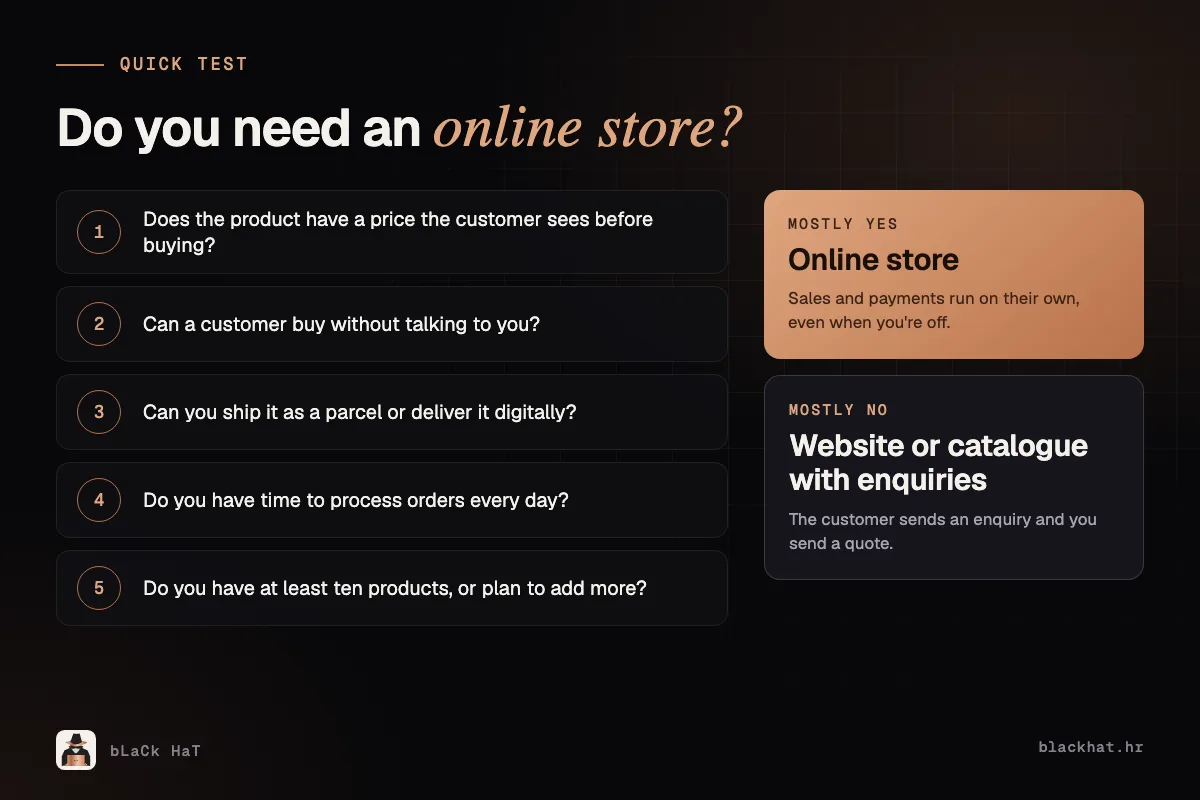
- Does the product have a price the customer sees before buying?
- Can a customer buy without talking to you?
- Can you ship it as a parcel or deliver it digitally?
- Do you have time to process orders every day?
- Do you have at least ten products, or will you add more regularly?
If you answered "yes" to most questions, an online store will pay off. If most answers are "no", start with a website or a catalogue with enquiries.
Can I start with a website and add a store later?
Yes, and it's often the smartest route. Launch the website first, see how many enquiries come in and for which products, then add the store as part of the same website (for example at /shop). You keep the domain, the design and your Google rankings. The condition is that the website is built to be extended from the start, so tell whoever builds it.
Frequently asked questions
Can I sell through a website without an online store?
Yes. With a catalogue with enquiries, the customer sends an order through a form, you send a quote or pro forma invoice, and the customer pays by bank transfer. For a small number of orders that's perfectly enough.
Do I need a registered business to run an online store?
Yes. To sell online you need a registered business (sole trader or company) with retail trade among its registered activities. Agree with your accountant what exactly to register and how to issue invoices before the build starts.
Is an online store a good fit for services, such as appointments or courses?
For services, online booking with payment for the slot usually works better than a classic cart. Customers see free slots straight away, and you avoid double bookings.
How long does it take to build an online store?
Usually 6 – 12 weeks, depending on the number of products, payment and delivery methods, and integrations with other systems. If product photos and descriptions are ready at the start, the store is finished sooner.
Not sure what you need?
Tell us what you sell and how customers find you today. We'll suggest the solution that fits your business, whether that's a website, a catalogue with enquiries or an online store, and spell out what's included and what it costs. Request a free quote.