Part two of our newsletter guide: how to plan content, write subject lines people open and keep subscribers reading every issue.
5. IMPRESS WITH THE FIRST SENTENCE OF YOUR EMAIL
Now that you've got readers to open your email, it's time to write an interesting first sentence.
Does that seem pointless? Pay attention to it, because the subject line isn't the only thing the recipient sees first!
The subject line is undeniably an important part of the newsletter story, but most email clients also show part of the first sentence in the inbox. In other words, an email doesn't have to be opened for someone to read a small part of it.
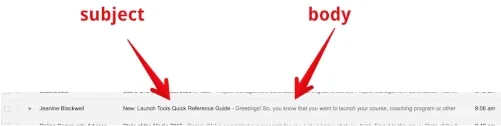
How much of the text is shown depends on the length of the subject line, so watch that detail too. Also keep mobile devices in mind, where a large part of the email text is shown on screen.
So what should the first sentence say?
We have already stressed the importance of personalisation, but try to avoid classic openings such as "Good afternoon, my name is…" and start instead with "we noticed that you…".
This approach lets readers connect with the content and picture themselves using the product or service you present.
You create an instant connection by cutting the small talk and getting straight to the point.
Jacob's email sums it up:
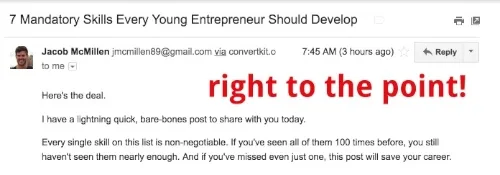
This shows the recipient that you respect them and value their time. Clear, short and concise information is always welcome.
6. CONNECT WITH THE RECIPIENT
The body of the email is where you finally connect with the recipient. This is where you present your product or service and link it to real life, showing it as something that will make life better.
We suggest short, clear text. Avoid piling up information that distracts and turns reading into a chore.
Write short, broken-up paragraphs in the second person. Address the reader as "you" and ask personal questions (don't overdo it) to create the feeling of a face-to-face conversation.
Examples of questions you can use:
- Do you have any other questions about the product or service?
- If you think you need to, how would you improve your strategy?
- Is (one of the product or service benefits) your priority right now?
In the end, the point of an email to a customer is to present clear, interesting text full of useful information.
7. BE CONSISTENT BUT NOT BORING
Your subscribers expect your newsletter, so make sure you keep your promises. Whether someone signed up for a weekly or a monthly newsletter, it's important to meet their expectations and confirm your reputation.
Building credibility is essential, and it will later show in how many subscribers convert.
Also take care not to send too many newsletters, because that can be off-putting and get flagged as spam – unwanted email.
The most common reasons a newsletter is reported as spam:
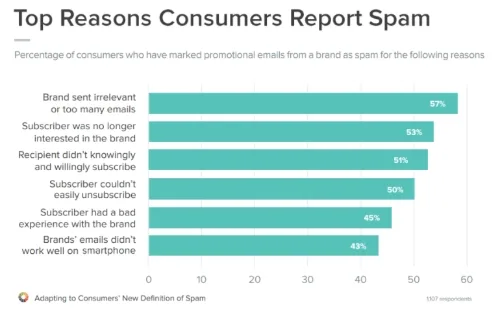
Stay organised and keep a consistent schedule – don't abuse the trust and privilege you have earned.
8. STICK TO RELEVANT FACTS
In the previous example you can see that, among other things, people don't want your newsletter because of irrelevant content. That is exactly why it's important to stay focused on your brand and topic throughout the text.
For example, if your business makes windows and doors, focus on that. Don't write about sport, the weather, politics or similar irrelevant topics that distract or tire the reader.
Interestingly, people perceive email content differently depending on the industry.
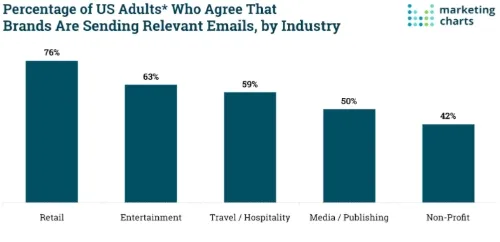
Make sure you send your readers relevant content, but also consider letting them choose what they want to read about. Let them choose how often they want to receive your newsletter, too.
You may feel this means more work writing weekly newsletters – and you're right. Writing more newsletters takes more time, but in the end your effort will pay off in a higher rate of subscribers turning into customers and users.
9. SUPPORT YOUR CONTENT WITH VISUALS, PHOTOS AND ILLUSTRATIONS
People are visual creatures first, and in today's busy world few will read endlessly long texts. Everyone knows a picture is worth a thousand words, so include interesting, relevant images in your newsletters.
Interestingly, the average subscriber spends only 51 seconds reading a newsletter and actually "reads" only 20% of the text, so it's important to create content that is easy to skim.
Also try including video in your newsletters. Subscribers then don't have to read every word and still get the point of your email.
See how visual information affects the reader:
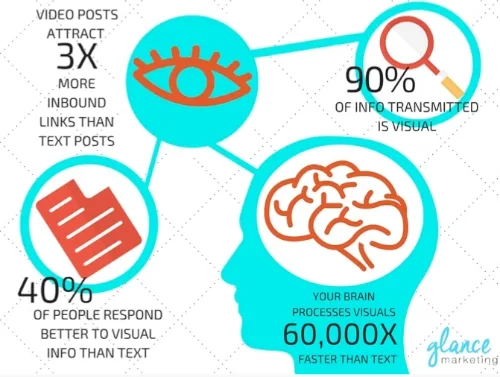
With photos and video you create content that makes an impression and is quickly taken in. Visuals speed up how information is received and remembered, so be creative and give your newsletters a signature look.
10. MEASURE SUCCESS AND RESULTS
The only way to know whether your newsletter works is to measure its conversion rate. Whatever software you use, we recommend building tracking straight into the platform, so you can easily follow open and bounce rates, clicks, unsubscribes and how many people read the content.
Tools like these help us identify which newsletters subscribers liked best.
If some of your newsletters had a disastrous conversion rate, use those bad examples to improve and to understand what your audience needs.
So make the effort to actively track and review the results of every campaign.